Stereochron Island
ARTIST RESIDENCY IN VICTORIA PARK FOR CHISENHALE GALLERY (2013-14)
This public research project playfully re-imagined Victoria Park in East London as a tiny state, Stereochron Island, that was campaigning to liberate itself from the mechanical clock.
The campaign’s founding premise was that our sense of being ‘time poor’ isn’t only because of the daily grind. It’s also because of a lack of fullness and variety in the kinds of time we comprehend, experience, value and craft. The Stereochron Island campaign called for a collective investigation into the seemingly rarer, more multi-sensory kinds of time that the park protects from the pressures of the clock and the surrounding city. Simply put, we were searching for time in ‘stereo’.
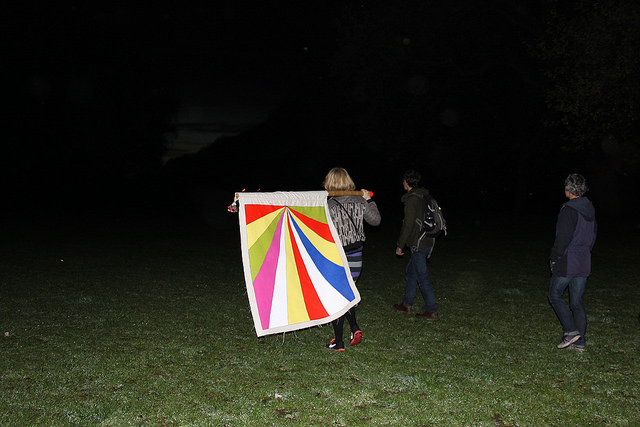
As Campaign Secretary, I invited specialists in ecology and astronomy to co-lead field studies in collaboration with the island’s inhabitants (park visitors). We began in spring by assembling in the darkness for an ecstatic dawn chorus. As the seasons moved on, we tuned into the rhythms of plants, plotted the shadows of ordinary things, explored the constantly shifting relationship of our island to the sky, and experimented with mapping our internal sense of the direction and shape of time. Our research culminated with a final gathering in late summer: after presenting a manifesto, I invited cellist Natalie Rosario to respond to the sounds of the island as dusk was falling.
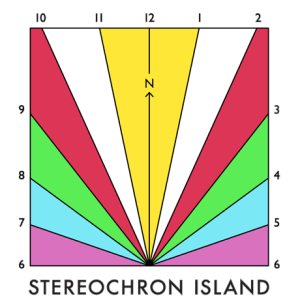
A selection of campaign artefacts:
Cautionary notices for clock users
Stereochron Island (2014) was commissioned and produced by Chisenhale Gallery, London.
Stereochron flag design by Fraser Muggeridge studio; photo of our trip to hear the island’s dawn chorus by Maria Eisl.
 Cathy Haynes