No Such Place
RESEARCH PROJECT & EXHIBITION
Old sea charts are dotted with phantom islands: landforms that never existed or were lost under the ocean. Only their names hint at what their finders saw. Was Bale of Cotton named for soft chalk cliffs? What sadness inspired the appellation Enfant Perdu (Lost Child)? How did the Atlantic Isle come to be in the Pacific?
In 2010 the curator Alfredo Cramerotti commissioned me to make a research project on fictional maps for Derby QUAD. This gift of a project sent me on a chase through libraries, flea markets and the Internet looking for falsehood and fantasy in what looks like factually exact cartography. No Such Place was the story-led exhibition that came out of that research. It uncovered phantom landforms, fraudulent claims, secret codes and private jokes hidden in official charts. It gathered propaganda maps and utopian blueprints. And it explored the fictions in maps of historical events.
No Such Place presented 40 maps in the form of antique prints, ephemera, photocopies, tracings on paper, hand drawn diagrams, flatscreen displays and video projection. It was displayed in the gallery’s unofficial exhibition spaces: lobbies, corridors and staircases. This miscellaneous mix of sources – presented without historical order in transient places in the building – reinforced the ambiguity of the material. The wall captions, too, had a more questioning, personal voice than traditional museum displays. By being open about my own partial perspective, I hoped to invite the visitor to join me in creating their own route through the evidence.
Looking back, Alfredo reflected: ‘No Such Place was a kind of autobiographical map – it plotted the landscape of ideas inside Cathy’s head, including the routes connecting apparently distant topics.’
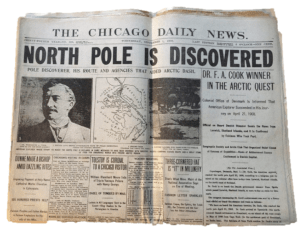
My collection continued to grow after the exhibition. Soon afterwards, I found this American newspaper from 1908, above, in a London flea market. The front page declares Dr. F. A. Cook’s ‘discovery’ of the North Pole – a claim that was later heavily mired in doubt.
 Cathy Haynes